Pulkit Garg, Ph.D.

Defect Engineering via Computational Design of Materials

Assistant Professor | Mechanical, Industrial and Manufacturing Engineering

University of Toledo

About

Pulkit Garg

Pulkit Garg, Ph.D.

Assistant Professor

Mechanical, Industrial and Manufacturing Engineering

University of Toledo

Location

Nitschke Hall 4050

2801 W. Bancroft St

Toledo, OH 43606

I am an Assistant Professor in Mechanical, Industrial and Manufacturing Engineering at the University of Toledo. My research interests include defect engineering, refractory multi-principal element alloys (MPEAs), nanocrystalline alloys, superconducting metals, and AI/ML-accelerated materials discovery.

Building on over a decade of expertise in multi-physics and multiscale modeling, I lead the DECODE (Defect Engineering via Computational Design) Materials Lab at the University of Toledo, which develops defect-informed computational approaches for designing materials with enhanced properties for applications in aerospace, hypersonic systems, energy, defense and national security, and quantum technologies.

My research program bridges quantum-mechanical first-principles (DFT) calculations, molecular dynamics (MD), and mesoscale phase-field dislocation dynamics (PFDD) to uncover the fundamental mechanisms governing material performance at every length scale. I have developed deep expertise in refractory multi-principal element alloys (MPEAs), nanocrystalline alloys, amorphous grain boundary complexions, and superconducting niobium, with growing efforts in AI/ML-accelerated materials discovery and 2D MXenes for energy storage.

Research Interests

  • Multi-principal element alloys (MPEAs / HEAs)
  • Dislocation dynamics & defect engineering
  • Interfacial segregation & amorphous grain boundaries
  • First-principles (DFT) calculations
  • AI / ML for accelerated alloy design
  • Multiscale modeling: DFT → MD → PFDD
  • Nanocrystalline alloys

Education

Ph.D., Materials Science & Engineering
Arizona State University, Tempe
Dec 2019
Advisor Prof. Kiran N. Solanki
Dissertation "The effect of defects on functional properties of Niobium for superconducting radio-frequency cavities: A first-principles study."
BS & MS, Ceramic Engineering
Indian Institute of Technology (BHU) Varanasi
July 2014
Advisor Prof. Devendra Kumar
Dissertation "Effect of processing parameters on structural and mechanical properties of Graphene reinforced Aluminum matrix composites."

Research

The DECODE Materials Lab pursues four interrelated research thrusts centered on defect-informed computational design of advanced materials.

Thrust 1

Multiscale Modeling Methods

Our research spans quantum to continuum length scales, enabling a comprehensive mechanistic understanding of material behavior from individual atoms to engineering components. We integrate and extend these methods to tackle problems at the forefront of materials science.

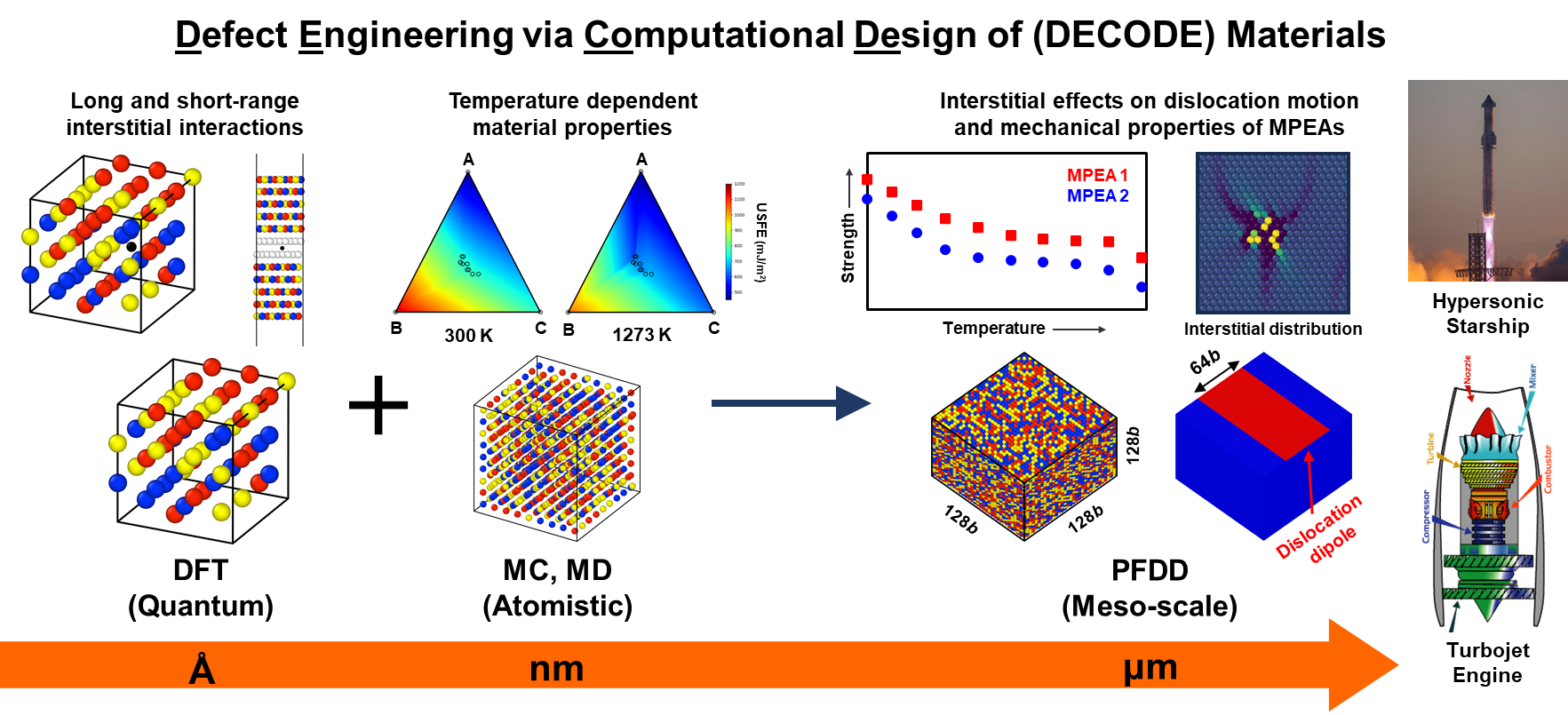
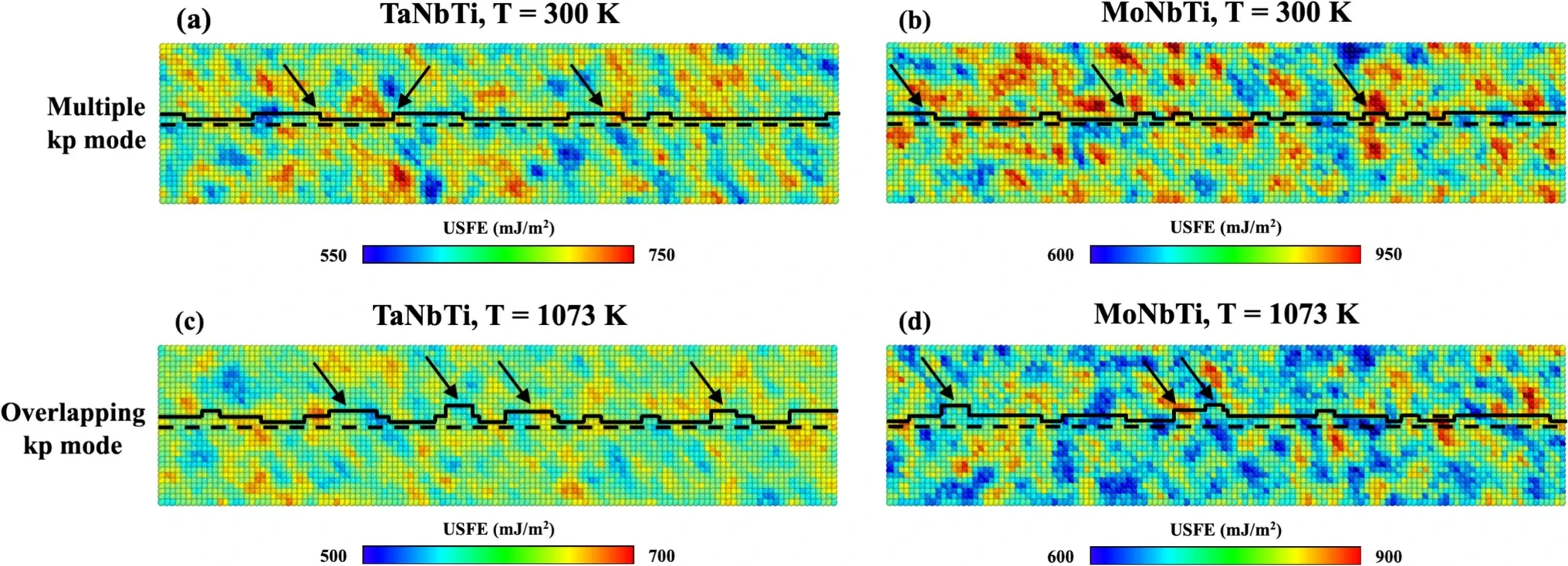
We employ DFT + MD + PFDD to reveal how interstitial impurities (O, H, C) and chemical disorder govern temperature-dependent dislocation dynamics in refractory MPEAs:enabling design of alloys for aerospace, hypersonic, and nuclear energy applications.

DFT (VASP) Molecular Dynamics (LAMMPS) Phase-Field Dislocation Dynamics Kinetic Monte Carlo Dislocation Dynamics BCC Alloys

Applications: Aerospace · Hypersonic vehicles · Nuclear energy · Quantum technologies · Energy storage

DECODE multiscale modeling approach: DFT to MD to PFDD
Fig. 1: The DECODE multiscale modeling framework integrating quantum (DFT), atomistic (MC/MD), and mesoscale (PFDD) methods to study and design MPEAs for high-temperature structural applications.
Thrust 2

Multifunctional Multi-Principal Element Alloys

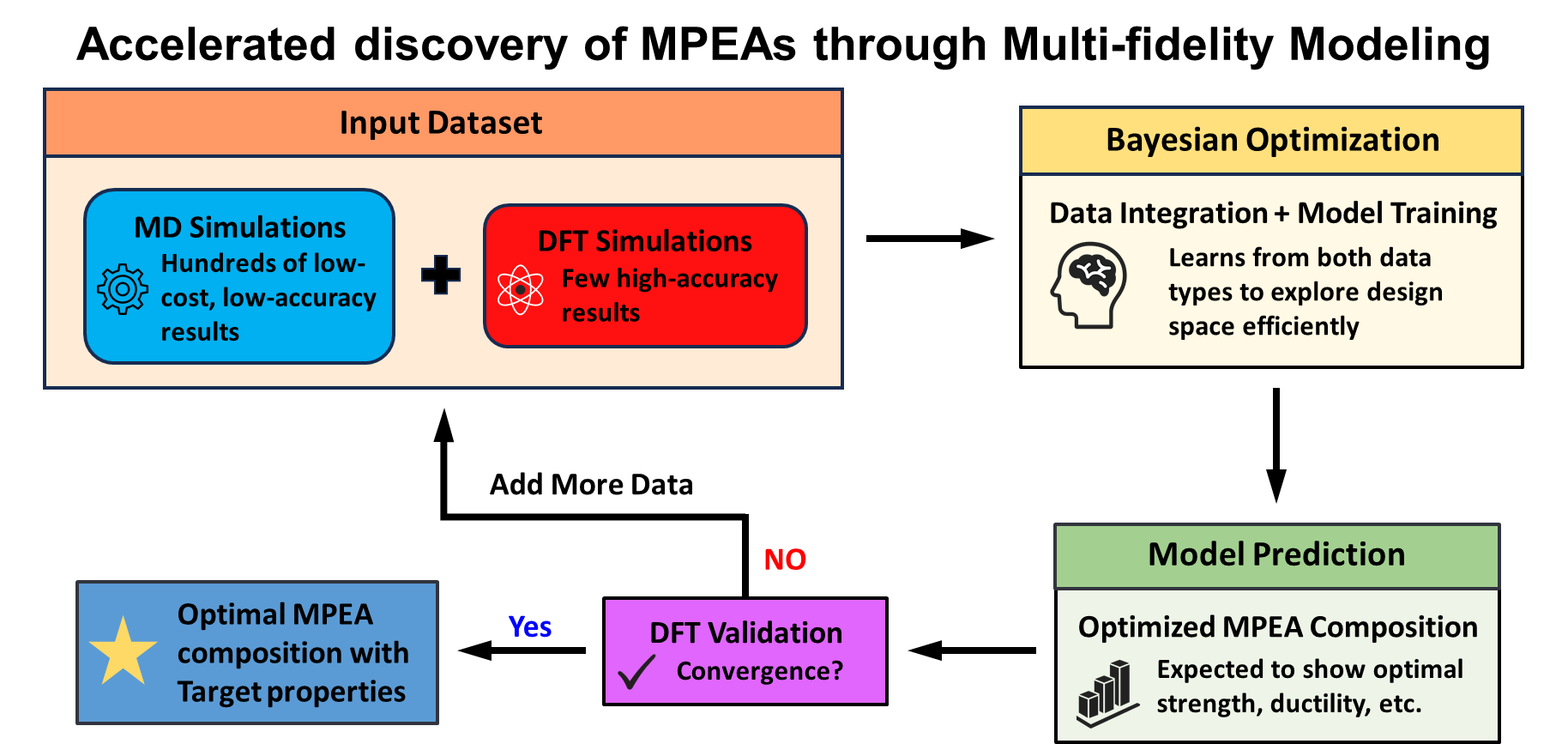
MPEAs offer exceptional combinations of thermal stability, mechanical performance, and functional properties inaccessible to conventional alloys. We develop a multi-fidelity Bayesian optimization framework combining large, low-cost MD datasets with high-accuracy DFT calculations to efficiently navigate the vast compositional landscape and predict new alloys with tailored properties.

AI / ML Machine Learning Bayesian Optimization DFT
Multi-fidelity predictive model workflow for accelerated MPEA discovery
Fig. 2: Workflow of a multi-fidelity predictive model combining low-cost MD and high-accuracy DFT datasets via Bayesian optimization to accelerate discovery of MPEAs with optimized properties.
Thrust 3

Nanocrystalline Alloys for Extreme Environments

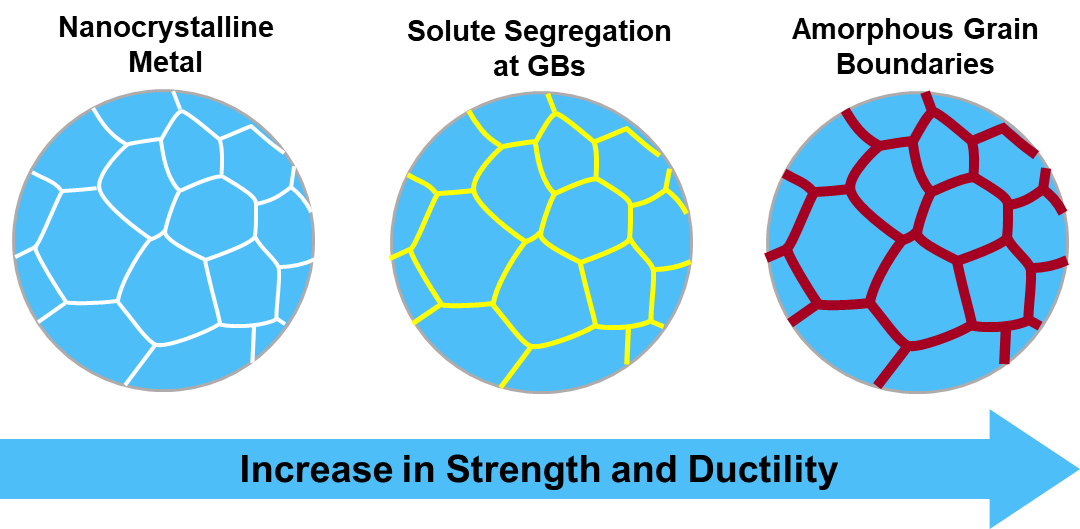
Nanocrystalline metals offer superior strength but suffer from thermal instability driven by high-energy grain boundaries. We use hybrid Monte Carlo / MD simulations to investigate how multiple solutes (Zr, Ta, Ag, Nb) co-segregate to boundaries and induce amorphous grain boundary complexion transitions that simultaneously enhance strength, ductility, and chemical stability.

This work provides design rules for thermally stable nanocrystalline alloys capable of retaining exceptional properties under extreme mechanical and thermal conditions.

Grain Boundary Complexions Monte Carlo / MD Segregation Nanocrystalline Metals Extreme Environments
Enhanced strength and ductility via amorphous grain boundaries in nanocrystalline alloys
Fig. 3: Enhanced strength and ductility in multicomponent nanocrystalline alloys through solute segregation-driven amorphous grain boundary formation under extreme conditions.
Future Expansion

2D Transition Metal MXenes for Energy Storage

Two-dimensional MXenes hold unique potential for lithium-ion and sodium-ion battery applications, yet their structure–property relationships remain poorly understood. We will apply first-principles quantum mechanical methods to systematically investigate stability, surface chemistry, mechanical response, and electronic properties of MXenes, bridging to larger scales via atomistic and continuum modeling.

This direction builds on our expertise in linking defects and interfaces to macroscopic properties, targeting the U.S. Department of Energy, Office of Basic Energy Sciences.

MXenes First-Principles Energy Storage 2D Materials Li / Na-ion Batteries

Publications

30 publications · 17 first-author · 1,400+ citations · i10-index: 16 · Google Scholar Profile

CV

Education

Ph.D., Materials Science & Engineering
Arizona State University
Advisor: Prof. Kiran N. Solanki
Dissertation: "The effect of defects on functional properties of Niobium for superconducting radio-frequency cavities: A first-principles study."
BS & MS, Ceramic Engineering
Indian Institute of Technology (BHU) Varanasi
Advisor: Prof. Devendra Kumar
Dissertation: "Effect of processing parameters on structural and mechanical properties of Graphene reinforced Aluminum matrix composites."

Professional Appointments

Assistant Professor
Mechanical, Industrial and Manufacturing Engineering
University of Toledo
Postdoctoral Researcher
Mechanical Engineering, UC Santa Barbara
Prof. Irene J. Beyerlein
Postdoctoral Scholar
Materials Science & Engineering, UC Irvine
Prof. Timothy J. Rupert
Postdoctoral Researcher
Materials Science & Engineering, Arizona State University
Prof. Kiran N. Solanki

Awards & Recognition

  • Best Young Researcher Award (Engineering, Below 40):4th International Academic and Research Excellence Awards (IARE), 2022
  • Travel Award:10th International Conference on Multiscale Materials Modeling (MMM10), Baltimore, MD, Oct 2022
  • Graduate Travel Award:School for Engineering of Matter, Transport and Energy, Arizona State University, 2017

Service & Mentorship

  • Graduate Poster Contest Judge:Materials Science and Technology (MS&T) Conference, 2024
  • Research mentor for incoming graduate students:UC Santa Barbara
  • Manuscript reviewer (>40 manuscripts):Acta Materialia, Physical Review Materials, Computational Materials Science, and others

Download the full curriculum vitae for complete publication list, presentations, and service record.

↓ Download Full CV (PDF)